

Bending fatigue resistance is a crucial property when evaluating the performance and durability of Acrylic Conductive Yarn. As a leading supplier of Acrylic Conductive Yarn, we understand the significance of this characteristic and its impact on various applications. In this blog, we will delve into what bending fatigue resistance of Acrylic Conductive Yarn entails, why it matters, and how it is measured.
Understanding Bending Fatigue Resistance
Bending fatigue resistance refers to the ability of a material to withstand repeated bending or flexing without experiencing significant damage or a loss of its functional properties. In the case of Acrylic Conductive Yarn, this means that the yarn can endure multiple cycles of bending without losing its electrical conductivity, structural integrity, or other essential characteristics.
When an Acrylic Conductive Yarn is bent, it undergoes stress and strain. The outer fibers of the yarn are stretched, while the inner fibers are compressed. Over time, these repeated cycles of stretching and compression can cause micro - cracks to form in the yarn. If the bending fatigue resistance is poor, these micro - cracks can grow and eventually lead to the breakage of the yarn, which in turn can result in a loss of electrical conductivity and a decrease in the overall performance of the product in which the yarn is used.
Why Bending Fatigue Resistance Matters
The importance of bending fatigue resistance in Acrylic Conductive Yarn cannot be overstated, especially considering its wide range of applications.

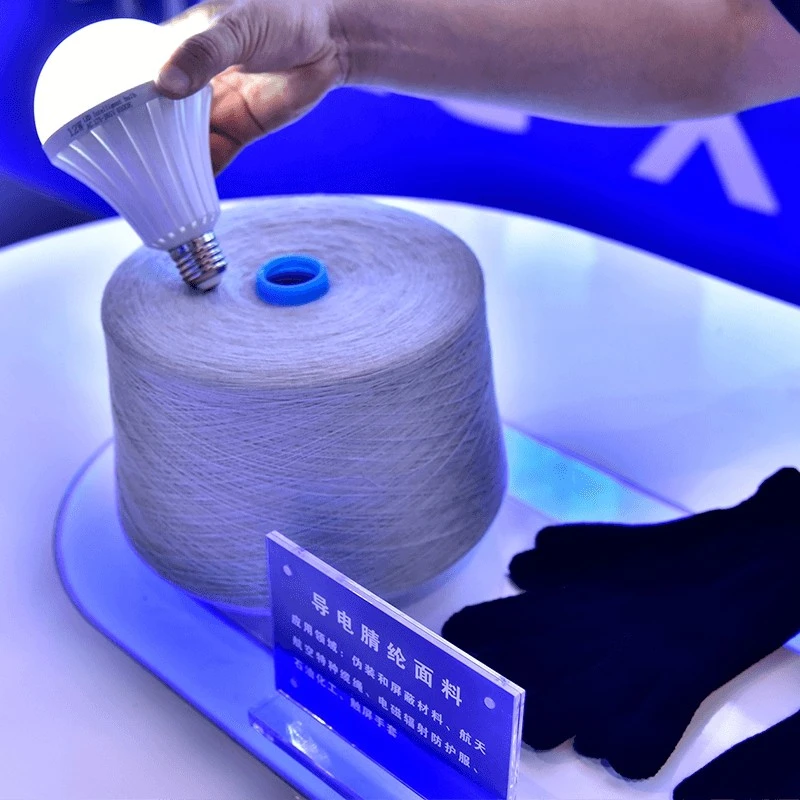
Wearable Electronics
One of the most prominent applications of Acrylic Conductive Yarn is in wearable electronics. In smart clothing, for example, the yarn is used to create circuits that can sense body temperature, heart rate, and other vital signs. Since clothing is constantly being bent and flexed as the wearer moves, the Acrylic Conductive Yarn must have excellent bending fatigue resistance to ensure that the circuits remain functional over an extended period. If the yarn breaks due to poor bending fatigue resistance, the smart clothing will no longer be able to perform its intended functions.
Industrial Applications
In industrial settings, Acrylic Conductive Yarn is often used in cables and wiring systems. These cables may be subject to repeated bending during installation, maintenance, or normal operation. A high bending fatigue resistance ensures that the cables can withstand these mechanical stresses without failing, which is essential for the reliable operation of industrial equipment.
Medical Devices
Medical devices also rely on Acrylic Conductive Yarn for various functions, such as monitoring and treatment. For instance, in electrotherapy devices, the yarn is used to transmit electrical signals. Since these devices may be bent or flexed during use, the yarn's ability to resist bending fatigue is crucial to maintain the accuracy and effectiveness of the treatment.
Factors Affecting Bending Fatigue Resistance
Several factors can influence the bending fatigue resistance of Acrylic Conductive Yarn.
Material Composition
The composition of the acrylic polymer and the conductive additives used in the yarn plays a significant role in determining its bending fatigue resistance. High - quality acrylic polymers with good elasticity and strength can better withstand the stresses associated with bending. Additionally, the type and amount of conductive additives can affect the yarn's flexibility and durability. For example, some conductive additives may make the yarn more brittle, reducing its bending fatigue resistance.
Yarn Structure
The structure of the Acrylic Conductive Yarn, such as its twist level and cross - sectional shape, can also impact its bending fatigue resistance. A higher twist level can increase the yarn's strength and cohesion, making it more resistant to bending. However, too high a twist can also make the yarn stiffer and less flexible. The cross - sectional shape of the yarn can also affect how it distributes stress during bending. For example, a round cross - sectional shape may distribute stress more evenly than an irregular shape, resulting in better bending fatigue resistance.
Manufacturing Process
The manufacturing process of the Acrylic Conductive Yarn can have a profound effect on its bending fatigue resistance. Proper spinning, drawing, and heat - treating processes can optimize the yarn's structure and properties, enhancing its ability to resist bending fatigue. For example, heat - treating can improve the crystallinity of the acrylic polymer, increasing its strength and durability.
Measuring Bending Fatigue Resistance
There are several methods available for measuring the bending fatigue resistance of Acrylic Conductive Yarn.
Repeated Bending Test
One common method is the repeated bending test. In this test, a sample of the yarn is clamped at both ends and subjected to a specified number of bending cycles at a constant frequency and amplitude. After the test, the yarn is examined for signs of damage, such as breakage or a decrease in electrical conductivity. The number of cycles the yarn can withstand before failure is used as an indicator of its bending fatigue resistance.
Flexural Fatigue Test
The flexural fatigue test is another method used to evaluate the bending fatigue resistance of Acrylic Conductive Yarn. In this test, the yarn is placed on a support and a load is applied at the center of the yarn, causing it to bend. The load is then removed and reapplied repeatedly, simulating the bending action. The test continues until the yarn fails, and the number of cycles to failure is recorded.
Our Commitment as a Supplier
As a supplier of Acrylic Conductive Yarn, we are committed to providing our customers with products that have excellent bending fatigue resistance. We use high - quality raw materials and advanced manufacturing processes to ensure that our yarns can withstand the rigors of various applications. Our R & D team is constantly working on improving the bending fatigue resistance of our products through continuous innovation and optimization.
In addition to Acrylic Conductive Yarn, we also offer other high - quality industrial yarns, such as PE Anti - cutting Yarn and Aramid Anti - cutting Yarn. These yarns also have outstanding mechanical properties and are suitable for a wide range of applications.
If you are in the market for Acrylic Conductive Yarn or other industrial yarns, we invite you to contact us for more information. Our team of experts is ready to assist you in selecting the right products for your specific needs and to provide you with professional technical support. Whether you are a manufacturer of wearable electronics, industrial equipment, or medical devices, we can offer you high - performance yarns that meet your requirements.
References
- "Handbook of Fiber Science and Technology: Volume 3 - High - Performance Fibers" by Menachem Lewin and Eli M. Pearce
- "Textile Materials and Their Use in Engineering Applications" by A. K. Mohanty, M. Misra, and L. T. Drzal
- "Electroactive Polymer (EAP) Actuators as Artificial Muscles: Reality, Potential, and Challenges" by Yoseph Bar - Cohen