

As a seasoned supplier of linen viscose fabric, I'm thrilled to share the fascinating journey of how this remarkable textile is manufactured. Linen viscose fabric combines the natural elegance of linen with the softness and drape of viscose, resulting in a versatile and luxurious material that is highly sought after in the fashion and home decor industries.
The Raw Materials
The manufacturing process of linen viscose fabric begins with the selection of high - quality raw materials. Linen is derived from the fibers of the flax plant. Flax is an ancient crop known for its strength and durability. The long, fine fibers are obtained from the stalks of the flax plant through a process called retting, which involves soaking the stalks in water to break down the pectin that binds the fibers together. After retting, the fibers are separated from the woody core of the stalk through a process called scutching and then further refined through hackling to remove any remaining impurities and align the fibers.

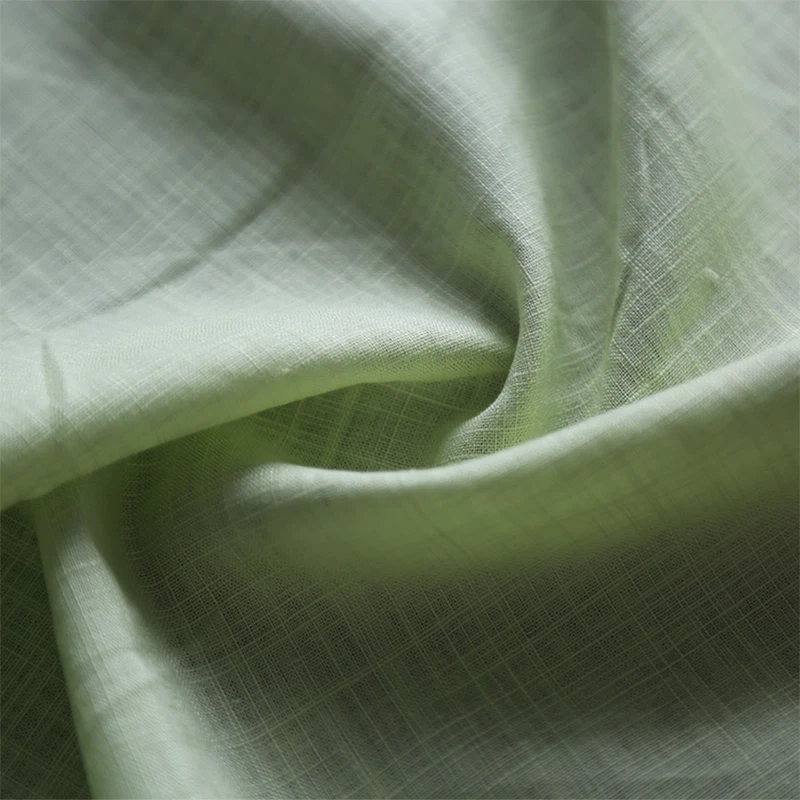
Viscose, on the other hand, is a semi - synthetic fiber made from cellulose. The cellulose is typically sourced from wood pulp, most commonly from trees such as beech, pine, or eucalyptus. The wood pulp is first treated with chemicals to break it down into a viscous solution. This solution is then forced through tiny holes in a spinneret to form filaments, which are then solidified and washed to remove any remaining chemicals.
Spinning the Yarn
Once the raw materials are prepared, the next step is to spin them into yarn. There are two main methods for spinning linen viscose yarn: the ring - spinning method and the open - end spinning method.
In the ring - spinning method, the linen and viscose fibers are first blended together in the desired ratio. This blending process ensures that the resulting yarn has the combined properties of both fibers. The blended fibers are then passed through a series of rollers to draw them out and align them. The drawn - out fibers are then twisted around a spindle to form a continuous yarn. Ring - spinning produces a smooth, fine yarn with high strength and a uniform appearance.
The open - end spinning method is a more modern and efficient process. In this method, the blended fibers are fed into a rotor where they are twisted together to form yarn. Open - end spinning is faster and can produce yarn with a slightly coarser texture compared to ring - spinning. However, it is also more suitable for producing bulkier yarns and is often used for making fabrics with a more casual or rustic look.
Weaving or Knitting the Fabric
After the yarn is spun, it is ready to be woven or knitted into fabric. Weaving is the traditional method of creating fabric, where two sets of yarns, the warp (lengthwise yarns) and the weft (crosswise yarns), are interlaced at right angles. There are different types of weaves, each with its own unique characteristics.
The plain weave is the simplest and most common weave. In a plain weave, each weft yarn passes over and under each warp yarn in an alternating pattern. This creates a balanced, durable fabric with a smooth surface. The twill weave, on the other hand, has a diagonal pattern created by passing the weft yarn over a certain number of warp yarns and then under one or more warp yarns. Twill weaves are known for their strength and are often used for making denim and other heavy - duty fabrics.
Knitting is another method of creating fabric. In knitting, a single yarn is looped together to form a fabric. There are two main types of knitting: weft knitting and warp knitting. Weft knitting is more commonly used for making garments such as sweaters and socks, while warp knitting is often used for making lace and other lightweight fabrics.
Dyeing and Finishing
Once the fabric is woven or knitted, it is usually dyed to give it color. There are several methods of dyeing linen viscose fabric, including batch dyeing, continuous dyeing, and printing.
Batch dyeing involves immersing the fabric in a dye bath for a specific period of time to achieve the desired color. This method is suitable for small - scale production and allows for greater control over the dyeing process. Continuous dyeing, on the other hand, is a more efficient method for large - scale production. In continuous dyeing, the fabric is passed through a series of dye baths and drying chambers in a continuous process.
Printing is a method of applying patterns or designs to the fabric. There are different types of printing techniques, such as screen printing, digital printing, and block printing. Screen printing involves forcing dye through a stencil onto the fabric, while digital printing uses a computer - controlled printer to apply the dye directly to the fabric. Block printing is a traditional method where a carved block is dipped in dye and then stamped onto the fabric.
After dyeing and printing, the fabric undergoes a series of finishing processes to improve its appearance, feel, and performance. These finishing processes may include sand washing, which gives the fabric a soft, worn - in look; mercerizing, which improves the fabric's strength and luster; and anti - wrinkling treatments, which help the fabric to retain its shape and resist wrinkles.
Examples of Our Linen Viscose Fabrics
We offer a wide range of linen viscose fabrics, each with its own unique characteristics. For instance, our Linen Viscose Sand Washing Fabric has a soft, textured surface that is perfect for creating casual and comfortable garments. The sand - washing process gives the fabric a natural, aged look that is highly fashionable.
Our Viscose Linen Slub Fabric features irregular thick and thin areas in the yarn, creating a unique and interesting texture. This fabric is ideal for making statement pieces such as dresses and jackets.
The Soft Linen Viscose Dyed Fabric is known for its softness and vibrant colors. It is a great choice for making summer clothing and home decor items.
Conclusion
The manufacturing process of linen viscose fabric is a complex and intricate one that involves several stages, from the selection of raw materials to the final finishing touches. Each stage plays a crucial role in determining the quality and characteristics of the final fabric. As a supplier, we are committed to using the highest quality materials and the most advanced manufacturing techniques to produce linen viscose fabrics that meet the highest standards of excellence.
If you are interested in purchasing our linen viscose fabrics, we invite you to contact us for a detailed discussion. Whether you are a fashion designer looking for the perfect fabric for your next collection or a home decorator in search of a unique and luxurious material, we have the expertise and the products to meet your needs.
References
- Textile Institute. (2018). Handbook of Textile Fibre Structure. Woodhead Publishing.
- Morton, W. E., & Hearle, J. W. S. (2008). Physical Properties of Textile Fibres. Woodhead Publishing.
- Postle, R. (2012). Textile Science. Pearson Education.